Telling a Child They Are Donor Conceived
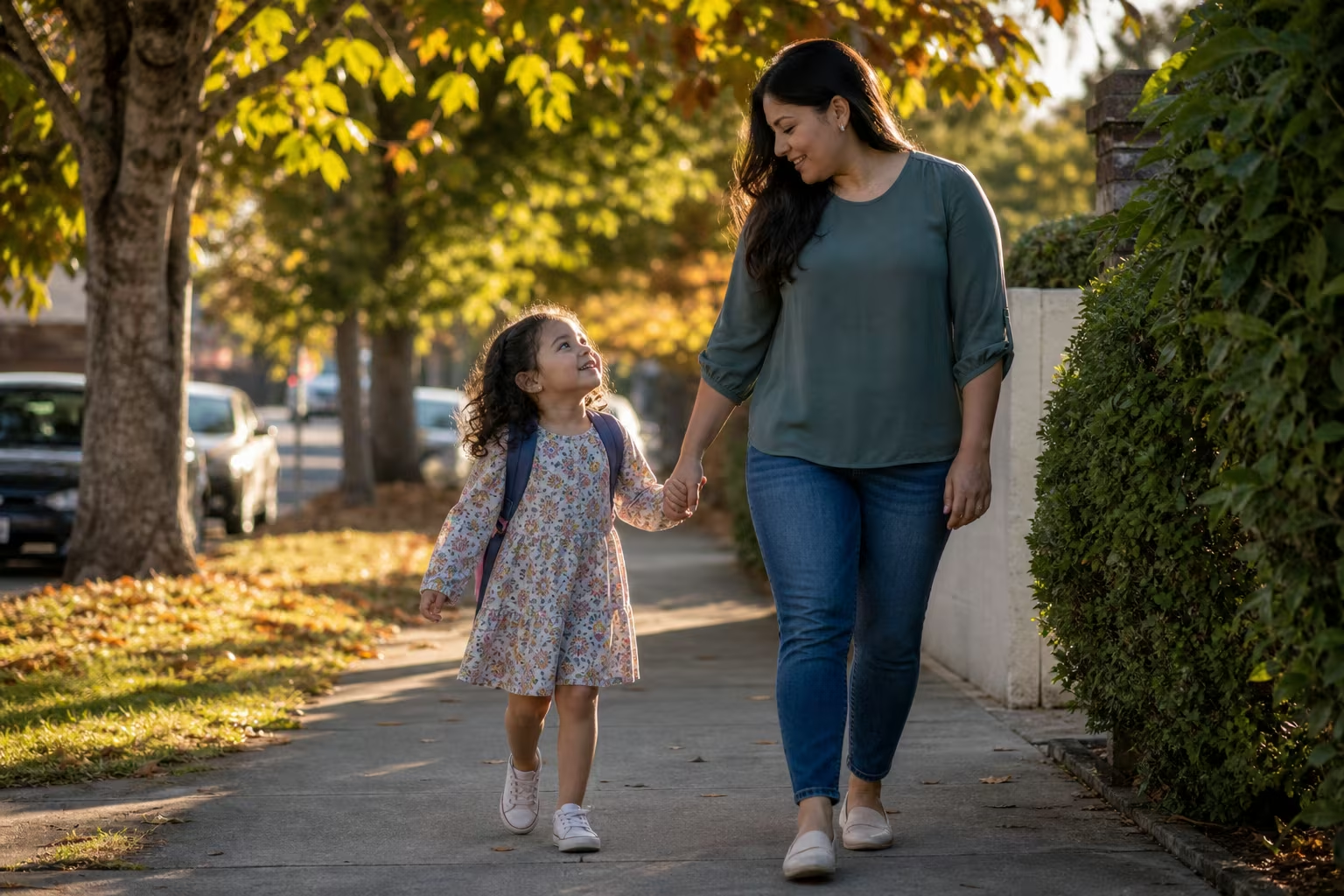
Research on families followed to adulthood points to telling before a child starts school, in ordinary language, as part of a story they always knew. Children told before age seven report better family communication and fewer relationship problems in adulthood than those told later. Telling is a series of small conversations rather than one announcement.
That finding holds wherever the family lives, which is why this guide covers it once for everyone. What differs by country is who counts as a legal parent and what information a donor-conceived person can later request, and those questions belong on the country pages for the United States and the United Kingdom.
When is the best age to tell a child they are donor conceived?
Before they start school. The organizations that publish guidance on this converge on the preschool years, and the reason is practical: a child under five absorbs the information as an ordinary fact about their own family, without having to revise anything they already believed.
The Donor Conception Network, which has published parent guidance on this since 1993, recommends beginning before a child is about seven and ideally before five. Its stated goal is that a child should grow up unable to remember a time when they did not know. The UK regulator, the Human Fertilisation and Embryology Authority, gives the same advice, noting that research favors talking to a child at an early age and that finding out suddenly in later life can be emotionally damaging for donor-conceived people and their families.
Age three or four is early enough that the words arrive before the questions do. A child that age is not asking how conception works. They are asking who is in their family, and a simple answer to that question is enough for several years.
What does the research actually say about telling early?
The strongest evidence comes from a study that followed the same families for twenty years and found measurable differences at age 20 between those who told early and those who told later. The differences were modest in size and consistent in direction.
Researchers at the University of Cambridge followed 65 UK families formed through third-party assisted reproduction, 22 by surrogacy, 17 by egg donation and 26 by sperm donation, from infancy to age 20, alongside 52 families who conceived without assistance. The results, published in Developmental Psychology in 2023, found no difference in psychological wellbeing or in the quality of family relationships between the two groups at age 20.
Within the assisted reproduction families, the timing of telling did show up. Among mothers who had told by age seven, 7 percent reported problems in family relationships, compared with 22 percent of those who told after age seven. Among the young adults themselves, 12.5 percent of those told before seven reported problems on the same questionnaire, compared with 50 percent of those told later. Mothers who began telling during the preschool years also showed lower levels of anxiety and depression at the twenty-year assessment. Most parents who disclosed had done so by age four, and reported that the child took it well.
An earlier stage of the same research program, published by Ilioi and Golombok in the Journal of Child Psychology and Psychiatry in 2017 and covering ages 1 to 14, found the same pattern at adolescence: within disclosing families, more positive family relationships and higher wellbeing among those told before age seven.
Two things are worth holding onto from this. Donor conception itself did not predict how the children turned out. Telling late was associated with more strain than telling early, and the strain showed up in the parents as well as in the children.
Why do sperm donation families tell less often than other families?
They do, and by a wide margin. In the Cambridge study, 42 percent of sperm donation parents had told their child by age 20, compared with 88 percent of egg donation parents and 100 percent of parents through surrogacy.
The researchers link this to greater secrecy around sperm donation, including a greater reluctance among fathers than mothers to disclose that they are not the genetic parent, and a greater reluctance to keep talking about it after the first conversation. In the same study, young adults conceived by sperm donation reported poorer family communication than those conceived by egg donation.
Where a family is formed by a single parent or by two mothers, the arithmetic is different, since the absence of a genetic father is visible from the start and the question tends to arrive earlier. The pattern above concerns families where a non-genetic father is present and the fact of donation can be kept out of sight.

What do you actually say to a three-year-old?
A few sentences, in the middle of an ordinary day, with no build-up. Something close to: our family needed some help to start, and a kind man gave us a seed so that you could be born. Then you answer whatever they ask, and let the subject drop when they lose interest.
Three-year-olds handle this well because they treat it as a story about themselves. The information a parent finds heavy is, at that age, roughly as interesting as a story about the day they were born. Children commonly ask a question, accept the answer, and go back to what they were doing.
Useful features of a first telling: it uses real words, so nothing has to be corrected later. It is short. It is repeated, in the bath, in the car, at bedtime, in slightly different forms over months. It is factual about the parts that are known and honest about the parts that are not. A parent who says “I do not know that yet, and I will tell you when I do” has set up a pattern that survives the harder questions later.
Picture books are the standard tool here, and the Donor Conception Network publishes a Telling and Talking series split by age band, for parents of children aged 0 to 7, 8 to 11, 12 to 16, and 17 and over. Reading a story is easier than starting a conversation, which is most of why the books exist.
How does the conversation change between ages five and eleven?
The facts stay the same and the mechanics get filled in. Somewhere around six or seven a child works out that babies come from a sperm and an egg, and the earlier story gets reinterpreted in that light. This is the point at which a child told early revises the details, and a child told for the first time revises their whole family.
Questions in this range tend to be concrete. Who is he. What does he look like. Does he know about me. Do I have brothers and sisters somewhere. Can I meet him. Answering these well means knowing in advance what information you hold and what you are willing to share, because a vague answer at eight is remembered at fifteen.
Children also start comparing families at this age. A child who knows the story well enough to tell it in their own words is in a better position than one who has heard it once. Practicing the sentence they would use with a friend is a reasonable thing to do together, and it hands them control over who knows.
What do teenagers ask, and what gets harder?
Identity questions arrive with adolescence, and they are normal rather than a sign that anything went wrong. A teenager may want to know about medical history, about physical resemblance, about half-siblings, and about whether contact is possible.
The evidence that early telling helps does not mean that early-told teenagers have no questions. The 2020 survey published by We Are Donor Conceived, which collected 481 responses from donor-conceived people aged 13 to 74 across 15 countries, found that respondents who learned before age three were significantly more likely to describe their overall experience as positive, and equally interested in knowing the donor and any donor siblings. It is a self-selected sample recruited through online communities, so it describes the people who answered rather than the whole population, and on that point it is consistent with what the longitudinal work reports.
The same survey found that just over one third of respondents, 34 percent, said their parents were aware of their true feelings about being donor conceived. That gap is worth taking seriously by parents who assume a settled silence means the subject is closed.
What if you have already waited?
Later telling can still go well, and the research on strain concerns families where the information stayed hidden rather than families who started late. The HFEA states plainly that where circumstance or choice have led to telling a child later in life, this can still be done well with the right preparation and guidance.
Preparation, in practice, means deciding three things before the conversation. What you will say about why you waited, since that is the question that follows. What information you can offer immediately, including anything you know about the donor. Who else already knows, because a child discovering that relatives were told first has two things to absorb instead of one.
Professional support is a reasonable step rather than a sign of trouble. The American Society for Reproductive Medicine’s 2018 Ethics Committee opinion treats counseling and informed consent about disclosure as essential parts of donor conception for both donors and recipients. Counselors experienced in donor conception work with families at every stage, including families telling a teenager or an adult.
What happens if a child finds out from a DNA test instead?
They find out anyway, and without any of the framing a parent would have provided. Consumer DNA testing has made this the common route for people whose parents did not tell them.
In the 2020 We Are Donor Conceived survey, 37 percent of respondents discovered they were donor conceived as a result of taking a commercial DNA test such as 23andMe or AncestryDNA as an adult. Within the same sample, 78 percent said they had identified the donor through DNA testing, sometimes with the help of genetic genealogy or a search assistant, and 70 percent had identified at least one donor sibling that way.
The practical consequence for a family deciding whether to tell is that the decision is now about who tells and when, rather than about whether the information stays private. A test taken by a cousin can surface it. So can a school biology project, a blood type, or a medical history question at a doctor’s appointment.
Which words should you use for the donor?
Whatever your family can say comfortably and repeat for twenty years. There is no consensus term, and the survey evidence shows donor-conceived people themselves using several.
Asked what they call the person who provided half of their DNA, respondents to the 2020 We Are Donor Conceived survey most often chose biological father or biological mother, followed by sperm donor or egg donor, with donor father, genetic father and father also appearing. Different people in the same family may settle on different words, and a child may change theirs as they grow.
Two things are worth avoiding. Invented euphemisms that a child later has to unlearn, and words that carry a judgment about the donor in either direction. “The man who helped us” works at three. “Donor” works at eight. What matters more than the noun is that the subject can be raised at the dinner table without the room going quiet.

Who else should know, and who decides?
Family and close friends usually need to know before the child is old enough to be surprised by their reaction. After that, the decision belongs increasingly to the child, and handing it over deliberately is part of the process.
The order that causes least trouble is to tell the child first, or at least at the same time as everyone else. A child who learns that grandparents, an aunt and two family friends knew before they did tends to focus on that rather than on the donor.
Once a child is at school, telling them explicitly that this is their information to share is a small conversation with a long effect. Some children tell everyone. Some tell nobody. Both are fine, and children commonly move between the two as they get older.
Does anything change when the donor is known to the family?
The telling starts earlier, in one sense, since there is a person the child may already have met. What changes is that the child’s questions have answers immediately, and that the adults have to agree in advance on what the arrangement is called.
The practical groundwork for that happens before conception rather than after. What contact a donor expects with a child, what he wants his own family to know, and whether he is comfortable being known from the start are among the questions covered in the guide on meeting a donor for the first time. A child who has always known who someone is has nothing to be told later, which is the simplest version of early disclosure available.
Where a donor’s role changes over the years, and it often does, children handle the change better if the original description was accurate. Describing someone as an uncle or a family friend when the child will later learn otherwise creates the second conversation that early telling exists to avoid.
What about donor siblings?
They are part of the same information, and children ask about them early. Half-siblings in other families are usually the part of the story a child finds most interesting, and often the part parents have thought about least.
Numbers vary enormously depending on how the conception was arranged, and outside a regulated clinic there is no register keeping count. That makes it worth asking a donor how many families he has already helped and how he keeps track, which is covered in the first meeting guide. For a child, the honest answer is often that you do not know exactly, and that you will help them find out when they want to.
What is the platform’s role in any of this?
Worth stating plainly, since this guide is published by one. We are a matching platform. People create profiles, search, and message each other, and that is the entire product. We do not handle, store, test or ship anything biological, we are not a clinic or a sperm bank and are not affiliated with one, we do not verify identities, run background checks or screen anyone’s health, and we do not give medical, psychological or legal advice.
Nothing on this page is guidance for your family in particular. It is a summary of what published research and the organizations working in this field say, with sources, so that you can take it to someone qualified if you want to.
Frequently asked questions
Is my child too young to understand?
A three-year-old does not need to understand conception to hold the information. At that age the story is about who is in their family and how they came to be there, and the point of telling early is that the words arrive before the questions do. The Donor Conception Network recommends starting before about five, with the aim that a child never remembers being told.
Is it too late if my child is already ten?
No. The HFEA states that telling later can still be done well with the right preparation and guidance, and counselors experienced in donor conception work with families telling children, teenagers and adults. Preparation means deciding in advance what you will say about why you waited, what information you can offer immediately, and who else already knows.
What if my partner does not want to tell?
This is common in families where a father is not the genetic parent, and it is reflected in the research: in the Cambridge twenty-year study, 42 percent of sperm donation parents had told by age 20, compared with 88 percent of egg donation parents. Counseling before a decision is standard practice in clinics for exactly this reason, and ASRM treats counseling about disclosure as an essential part of donor conception.
Will telling damage my child's relationship with their non-genetic parent?
The twenty-year Cambridge study found no difference in psychological wellbeing or in the quality of family relationships between assisted reproduction families and unassisted conception families at age 20. Within the assisted reproduction group, the families who had told by age seven reported fewer relationship problems than those who told later, at 7 percent against 22 percent by mothers' report.
What if my child does not react at all?
That is the usual response from a young child, and it is not a sign that the message failed. Parents in the Cambridge study who disclosed in the preschool years commonly reported that the child took the news well. The information tends to resurface in questions weeks or months later, which is why telling works better as a repeated conversation than as a single event.
Should I wait until my child asks?
Children do not ask about something they have no reason to suspect. Waiting for a question in practice means waiting until adolescence or later, which is the timing associated with more reported strain in the longitudinal research, and it leaves open the possibility that a commercial DNA test gets there first.
How much should I tell my child about the donor?
What you know, in a form that fits their age, and an honest answer about what you do not know. Donor-conceived respondents to the 2020 We Are Donor Conceived survey placed high importance on identity and on family medical history, and children generally ask about appearance, other families and whether contact is possible. Deciding in advance what you hold and what you will share prevents an answer at eight that has to be corrected at fifteen.
Where can parents get help with this?
The Donor Conception Network publishes the Telling and Talking booklet series for parents of children aged 0 to 7, 8 to 11, 12 to 16 and 17 and over, and the HFEA points parents toward that series and toward counseling through professional bodies. ASRM's Ethics Committee describes counseling and informed consent about disclosure and information sharing as essential for donors and recipients alike.
The short version
Tell early, in ordinary words, and keep telling. The best available evidence, from families followed for twenty years, associates telling before school with better family communication and fewer reported relationship problems in adulthood, and finds no disadvantage to donor conception itself. Most parents who told early did so by age four and found the child took it easily.
If you have waited, start with preparation rather than with an announcement, and consider a counselor experienced in donor conception. If you are still deciding, the practical question is who tells your child and when, since consumer DNA testing has already made accidental discovery a common route, and 37 percent of respondents to one large community survey found out that way as adults.
The rest of the guides cover the parts that are the same wherever you live, including how home insemination works, finding your fertile window, what donor screening tests for and meeting a donor for the first time. The legal picture sits on the country pages, with common questions answered for the US and for the UK. You can create a profile at your own pace, read more about who we are, or get in touch if something here needs correcting.
Sources: Golombok et al., A longitudinal study of families formed through third-party assisted reproduction, Developmental Psychology 2023 · ASRM Ethics Committee, Informing offspring of their conception by gamete or embryo donation, 2018 · HFEA, Talk to your child about their origins · Donor Conception Network, Telling and Talking series · We Are Donor Conceived, 2020 Survey Report. Checked August 2026.